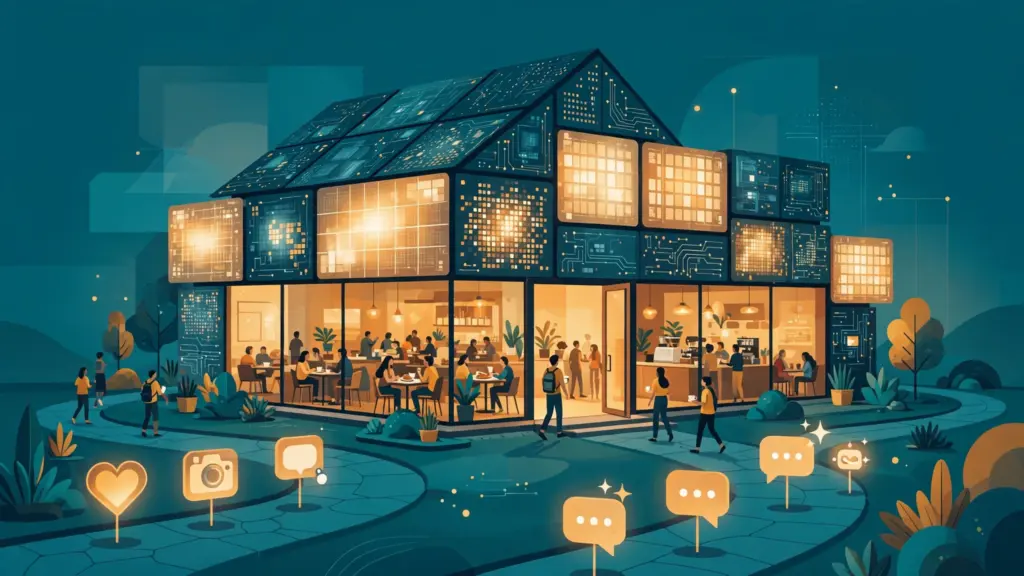
AI made websites easier to build. It did not make building a profitable business automatic.
That is the uncomfortable truth at the heart of this video. Anyone can spin up a good-looking site in an afternoon now. But most of those sites sit there like an empty café — beautiful, quiet, and making no money — while a packed café down the street turns people away at the door. The difference is not the décor. It is that one business gives people a reason to show up, buy, and come back, and the other does not.
The answer is not another website. It is what the video calls a Digital Home: one place you own, connected to your offers, your content, your landing pages, your email list, and your customer relationships.
Watch: Websites Are Dead. Build THIS Instead
Why most websites never make money
Most websites are digital brochures. They describe the business, list some services, and wait. Nobody has a reason to visit twice, because nothing new happens there and nothing is asked of them.
A profitable online presence works the other way around. It is a destination with a job to do: attract the right people, serve them something useful, and turn a visit into a relationship. If your site cannot do those three things, no amount of design polish will save it.
How AI is changing website traffic
The old game was ranking on Google and harvesting clicks. The new game is different: AI increasingly answers questions directly, which means fewer people click through to anyone’s site at all. Traffic is concentrating in the hands of businesses that AI systems can clearly understand, trust, and recommend.
That shift punishes vague websites and rewards clear ones. If an AI cannot tell in seconds what you do, who you serve, and why you are credible, it will recommend someone else.
If you want to get fluent with the AI tools reshaping traffic and business — automation, agents, and practical workflows — MentorNet is built for exactly that: AI mentors and hands-on resources for using AI better, not just reading about it.
Three common website problems
The pattern behind most failing sites comes down to three gaps. First, no clear reason to visit — the site says everything and therefore nothing. Second, no engine bringing people back — no content worth following, no list, no community. Third, no path from attention to revenue — visitors arrive, look around, and leave without ever being offered a next step.
Fixing any one of these helps. Fixing all three is what turns a brochure into a business.
Digital landlords and the attention economy
Most businesses today are tenants, not owners. Their audience lives on platforms they do not control — social feeds, marketplaces, app stores — and the landlord can change the rent, the rules, or the algorithm overnight.
The attention economy rewards whoever holds attention longest, and platforms are designed to keep it for themselves. Building your entire business on rented land means building on someone else’s terms. Owning your Digital Home flips that: social platforms become roads that lead to your house, not the house itself.
What it means to own your Digital Home
A Digital Home is one place you own where everything connects: your offers, your content, your landing pages, your email list, and your customer relationships. It is not a single page. It is a system with doors — many ways in, all leading to the same place.
When someone discovers you anywhere — a search, a social post, an AI answer — they should land somewhere that deepens the relationship instead of ending it.
Collection points: more ways to serve customers
Every interaction with your business is a chance to collect, not just to sell. An email signup, a community join, a booking, a purchase, a reply — each one is a collection point that turns a stranger into someone you can serve again.
Businesses with more collection points are harder to kill. Lose one traffic channel and the relationships you have already collected keep the business alive. Businesses with none are one algorithm change away from silence.
Three questions to ask about your website
Strip it down to three questions: does your site give people a reason to visit, a reason to buy, and a reason to return? If the answer to any of the three is fuzzy, that is where the work is.
Visit is about clarity and value — can a stranger tell in seconds why this is for them? Buy is about offers — is there a clear, easy next step? Return is about relationship — is there a reason to come back next week?
Does this contradict focusing on one offer?
No — it completes it. Focus on one core offer, but build many doors into it. The video’s point is that focus and breadth are not opposites: a single strong offer, served through multiple collection points and entry-level steps, reaches more of the right people than a dozen scattered offers ever will.
Building your value ladder
A value ladder is how strangers become customers and customers become bigger customers. It starts with something free and useful, steps up through low-cost offers, and climbs to your core and premium work. Each rung earns the right to offer the next one.
Without a ladder, every visitor faces the same all-or-nothing choice — buy the big thing or leave. With one, people can start small, get value, and climb at their own pace.
Small experiments that strengthen your business
You do not rebuild everything at once. You run small experiments: add one collection point, sharpen one offer, test one new entry step. Each experiment either strengthens the system or teaches you something, and the wins compound.
This is how small businesses beat bigger ones. Not with a bigger launch, but with a tighter loop of testing and improving.
The five layers of a Digital Home
The video lays out five layers that stack into a complete Digital Home — from the owned foundation at the bottom, through content and offers, up to the list and the customer relationships at the top. The layers matter because they build on each other: content without a home leaks attention, offers without a list have no one to hear them, and relationships without a system do not scale.
Build bottom-up, one layer at a time, and the whole thing gets stronger with every layer you finish.
How businesses get recommended by AI
AI recommendations are the new word of mouth, and they follow a simple logic: AI recommends what it can understand, verify, and trust. Clear positioning, specific offers, consistent content, and real proof — testimonials, case studies, a visible track record — all make your business easier for an AI to describe and defend to its user.
Vague claims and generic pages are invisible to this new gatekeeper. Specificity is the new SEO.
For more on how AI, automation, and marketing are colliding — and what it means for business owners — Martini Labs covers the intersection of AI, automation, business, and marketing as it happens.
Inside BraveBrand’s Digital Home — and the $35,000 ChatGPT client
This is not theory. The video walks through BraveBrand’s own Digital Home, and shares the proof: a client found BraveBrand through ChatGPT and turned into a $35,000 project. No ad, no cold outreach — an AI recommendation, earned by being clear, credible, and easy to find.
That is the prize on the table. AI is already sending real money to businesses it can understand. The question is whether yours is one of them.
Build yourself alongside the system
The final lesson is personal: build yourself alongside the system. The business grows as the owner grows — skills, clarity, judgment, and the willingness to keep experimenting. A Digital Home is not a one-time build; it is a practice.
If you want a full step-by-step system for building an AI-powered business — not just a website, but the whole machine — Digital Life Manager: The AI Business Empire Blueprint lays out the complete framework for turning AI tools into a real business empire.
The bottom line
Websites are dead in the sense that a website alone was never the business. What works now is a Digital Home: one place you own, with many doors in, a value ladder inside, collection points everywhere, and a clarity that both humans and AI can understand and recommend.
Start with the three questions. Give people a reason to visit, a reason to buy, and a reason to return. Then build the layers, one experiment at a time — and build yourself right alongside them.
Based on the video “Websites Are Dead. Build THIS Instead” by BraveBrand. Explore BraveBrand at bravebrand.com and join the community at skool.com/bravebrand.