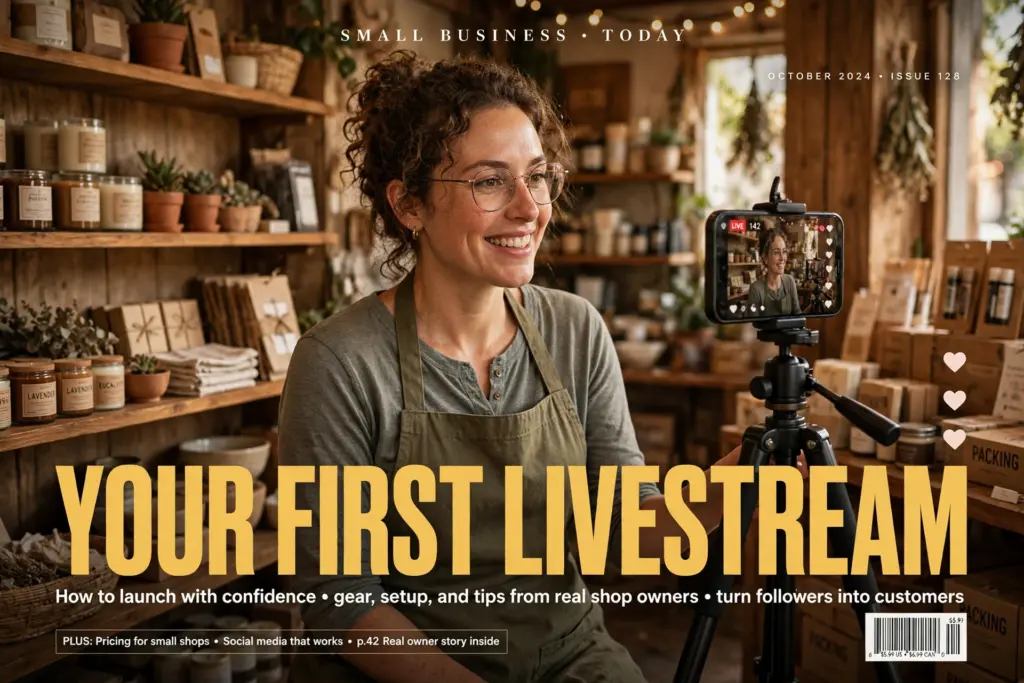
Your First Livestream Is a Sales Meeting You’re Not Holding Yet
Every week, your customers have questions they never ask you. They wonder whether your product fits their situation, whether the service is worth the price, what happens after they buy, and whether a real human stands behind the business. Those questions get answered somewhere — by a competitor’s video, a review site, or a rival who showed up on camera. The cheapest way to answer them yourself is a standing weekly livestream: thirty minutes, same time every week, run like the sales meeting it actually is.
That framing matters. Most small business owners treat a livestream as a performance, so they postpone it until they have a studio, a script, and confidence they will never feel. Treat it as a meeting instead — one you would happily hold in your shop or office — and the bar drops to where it belongs. You do not need to be entertaining. You need to be present, useful, and consistent.
“People don’t buy what you do; they buy why you do it.” — Simon Sinek
A livestream is the one format where customers hear your “why” in your own voice, unedited, every single week.
Why a Meeting, Not a Broadcast
A broadcast talks at an audience. A meeting answers the people in the room. The difference shows up in everything: a meeting has an agenda, a start time, a reason to attend, and a next step at the end. Your livestream should have all four.
- It replaces cold outreach with warm attendance. People who watch you work for thirty minutes arrive at a purchase already trusting you.
- It creates a weekly deadline for your marketing. One livestream produces the replay, the clips, the quotes, and the FAQ answers for the rest of the week.
- It compounds. Week one might draw three viewers. Week twelve draws thirty — and the first eleven replays are still working while you record the twelfth.
- It answers objections at scale. Every question one viewer asks live is a question fifty silent viewers also had.
The Zero-Fancy Setup
You already own almost everything you need. The gap between “not ready” and “live this Thursday” is mostly permission you give yourself.
- Camera: your phone or your laptop’s webcam. Viewers forgive a modest picture; they do not forgive bad audio.
- Audio: any wired earbuds or a basic USB microphone. This is the one upgrade worth making first.
- Light: face a window or put a lamp in front of you, never behind you. A bright face on a cheap camera beats a dark face on an expensive one.
- Software: a browser-based tool like StreamYard lets you go live on YouTube and Facebook at the same time, bring in a guest with a link, and show comments on screen — no production crew, no encoder settings to learn.
- A door that closes and a “live until :30” note on it. That is the whole studio.
Test once with an unlisted stream, watch the replay, fix the one thing that bothers you most, and then schedule the real one. Perfectionism past that point is just fear wearing a nicer outfit.
The 30-Minute Run of Show
Structure is what separates a meeting from a ramble. Use the same five blocks every week until they become muscle memory:
- Minutes 0–3 — The hook and the promise. Say exactly what viewers will get today: “In the next thirty minutes I’ll show you the three mistakes that ruin a first installation, and I’ll answer your questions live.” People stay for a promised payoff.
- Minutes 3–12 — The demo. Show the product, the process, or the before-and-after. Screen-share, hold the item up, walk to the workbench. Demonstration is the part a sales meeting does better than any advertisement.
- Minutes 12–20 — Teach one thing. A single useful lesson related to what you sell. Teaching builds the authority that makes the later offer feel like a continuation, not an interruption.
- Minutes 20–27 — Live Q&A. Read questions aloud, answer plainly, and when you don’t know, say so and promise the follow-up. Honesty on camera is a trust deposit no ad can buy.
- Minutes 27–30 — One clear next step. Not five links. One: book the call, visit the page, claim the offer. A meeting ends with a decision, and so should your stream.
Write the run of show on an index card. When you lose your place — and you will — the card brings you back without panic.
Replays Keep Selling After You Log Off
The live audience is the smallest audience your stream will ever have. The replay is the real asset. It gets indexed, shared, embedded, and watched at 11 p.m. by the person who buys at 9 a.m. Treat every stream as producing a permanent sales asset:
- Title the replay for search, not for the live moment. “How to Choose the Right Size (Live Q&A)” outlives “Tuesday Stream #6.”
- Pin the replay on your channel and your page, and link it from the product or service page it discussed.
- Cut two or three short clips from the best answers and post them during the week. Each clip is an advertisement for the replay and for next week’s meeting.
- Harvest the questions. Every live question becomes an FAQ entry, a social post, or the topic of a future stream.
“The live show is the appointment. The replay is the salesperson who never sleeps.”
The Mistakes That Make Business Livestreams Unwatchable
Most failed streams die from the same five causes, and all five are fixable:
- No agenda. Twenty minutes of “so, um, what’s new” teaches viewers to never return. If there is no promise, there is no reason to stay.
- Selling for thirty straight minutes. A pitch with no teaching or demonstration feels like a timeshare presentation. Give value first; the offer lands better at minute twenty-seven than minute two.
- Talking to nobody. Early streams have tiny audiences. Speak to the replay viewers and the one person watching quietly, or your energy collapses — and low energy is contagious through a screen.
- Tech fiddling on camera. Test audio and slides before you go live. Five minutes of “can you hear me?” burns the goodwill you came to build.
- No consistency. A stream “whenever you feel like it” never becomes an appointment in anyone’s week. Same day, same time, even when the audience is small — especially then.
Your First Four Weeks
Week one: announce the series and do a simple introduction-plus-demo stream. Week two: teach the most common beginner mistake in your field. Week three: bring a customer or partner on as a guest — interviews are easier than solo shows because conversation carries the energy. Week four: a pure Q&A built from every question the first three weeks surfaced. By the end of the month you will have a rhythm, four replays working for you, and a standing sales meeting your competitors are not holding.
Go Deeper: The Complete Streaming Guide
If you want the full system — gear decisions at every budget, run-of-show templates, platform settings, and the monetization playbook — that’s exactly what The Complete Streaming Guide was built for. It’s a 53-page, 10-module guide from StreamBase that takes you from your first stream to a real channel, in plain steps you can work through with a pen (the PDFs are print-and-write-in workbooks, designed to be filled out as you build).
Right now it’s $23.40 instead of $39 — code BLKFRIDAY7 takes 40% off through Monday, November 30, 2026, at 11:59 PM ET.
Get The Complete Streaming Guide on Gumroad
Book your first stream before you close this tab. Thursday, thirty minutes, one index card. The meeting is yours to hold.